
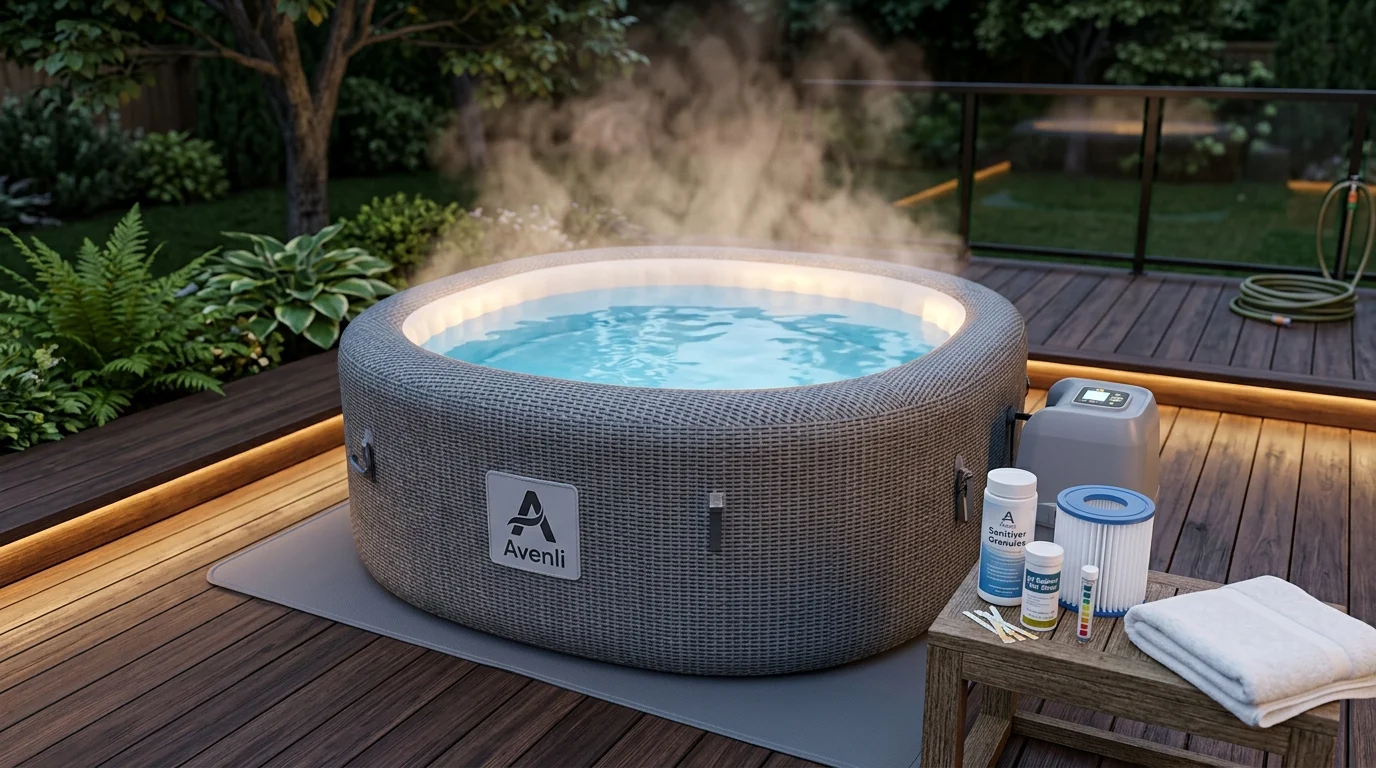
Hot tub water chemistry sounds like the kind of thing that requires a chemistry degree, but it really doesn’t. Once you understand what you’re actually trying to balance and why, the whole process becomes a straightforward routine that takes maybe 15 minutes a few times a week.The problem most first-time hot tub owners run into is they either ignore the water until something goes obviously wrong cloudy water, bad smell, skin irritation or they overthink it and dump in too many chemicals trying to fix things at once.
Water chemistry and temperature are closely connected the wrong temperature setting affects how quickly sanitizer burns through. Read our Best Temperature Setting for Inflatable Hot Tub guide to make sure your temperature habits aren’t working against your water chemistry routine.
Neither approach works. What does work is understanding the basics, testing regularly, and making small adjustments before problems have a chance to develop. This guide walks you through hot tub water chemistry in plain language, covering everything from pH and alkalinity to sanitizers, common problems, and a simple maintenance routine you can actually stick to.
Hot Tub Water Chemistry Basics — What You’re Actually Balancing?
Before you open a single bottle of chemicals, it helps to understand what the key numbers mean and why each one matters. Hot tub water chemistry comes down to four main values. Get all four in the right range and your water stays clear, clean, and comfortable. Let one slide and the others tend to follow.
The Four Core Values Every Hot Tub Owner Needs to Know:
| Chemical Parameter | Ideal Range | What Happens When It’s Off |
|---|---|---|
| pH Level | 7.2 – 7.8 | Too low = skin irritation, equipment corrosion. Too high = cloudy water, ineffective sanitizer |
| Total Alkalinity | 80 – 120 ppm | Low = pH swings wildly. High = pH locks up and won’t adjust |
| Calcium Hardness | 150 – 250 ppm | Too low = foamy, corrosive water. Too high = scale buildup on surfaces |
| Sanitizer (Chlorine) | 3 – 5 ppm | Too low = bacteria and algae grow. Too high = harsh smell, irritated eyes and skin |
Total alkalinity is the one people most often overlook, but it’s actually the foundation of everything else. Think of it as the buffer that stops your pH from swinging up and down every time you add water or use the tub. Get alkalinity right first, then adjust pH, then check sanitizer levels. Trying to fix pH when alkalinity is off is like trying to paint a wall that hasn’t been primed it won’t hold.
How to Balance Hot Tub Chemicals for Beginners?
If you’ve never balanced hot tub water before, the process feels more complicated than it actually is. The key is to adjust one thing at a time and always test before adding anything.
Step-by-step hot tub chemical balancing guide?
- Test the water first use test strips or a liquid test kit before touching any chemicals. Never guess
- Adjust total alkalinity first if it’s below 80 ppm, add an alkalinity increaser. If above 120 ppm, use pH reducer to bring it down gradually
- Balance pH next once alkalinity is stable, adjust pH to sit between 7.2 and 7.8 using pH increaser or pH reducer
- Check calcium hardness add a calcium hardness increaser if readings fall below 150 ppm. This step is often skipped but matters for equipment life
- Add your sanitizer chlorine tablets, granules, or bromine depending on your preference. Aim for 3 – 5 ppm for chlorine, 3 – 5 ppm for bromine
- Shock the water add a non-chlorine or chlorine shock treatment after balancing, especially on first fill or after heavy use
- Run the jets for 20 – 30 minutes this circulates the chemicals evenly throughout the water before anyone gets in
- Retest after 30 minutes confirm everything is in range before using the tub
One thing worth knowing always add chemicals to water, never water to chemicals. And space out additions by at least 20 minutes so each one has time to circulate before you test again.
How to Keep Hot Tub Water Crystal Clear?
Cloudy water is the most common complaint hot tub owners have, and it’s almost never one single cause. Usually it’s a combination of low sanitizer, high pH, and a filter that needs cleaning all happening at the same time.
If you’re maintaining your tub through a Canadian winter, water care becomes harder as heating cycles lengthen. Our Can You Use Inflatable Hot Tub in Winter Canada? guide covers the winter-specific setup habits that make water maintenance easier in cold conditions.
Why hot tub water goes cloudy?
- pH sitting above 7.8 for too long
- Sanitizer levels dropping below 1 ppm
- Filter cartridge clogged and not circulating properly
- Heavy bather load without a shock treatment afterward
- Body oils, lotions, and cosmetics building up in the water
- Tap water with high calcium content used to fill
How to fix cloudy hot tub water?
- Test pH and sanitizer adjust both if they’re out of range
- Clean or replace the filter cartridge
- Add a clarifier product to help small particles clump together so the filter can catch them
- Shock the water with a full dose and run jets for 30 minutes
- If cloudiness persists after 24 hours, do a full drain and refill
Common Hot Tub Water Problems and Quick Fixes:
| Problem | Most Likely Cause | Fix |
|---|---|---|
| Cloudy water | Low sanitizer, high pH, dirty filter | Adjust chemicals, clean filter, shock |
| Foamy water | Body products, low calcium hardness | Add defoamer, shower before use, adjust calcium |
| Bad smell | Chloramines, bacteria buildup | Shock treatment, check sanitizer levels |
| Skin or eye irritation | pH too low or sanitizer too high | Test and adjust pH, reduce chlorine dose |
| Slippery surfaces | Biofilm or algae starting to form | Scrub surfaces, shock treat, clean filter |
| Scale on surfaces | Calcium hardness too high | Use a stain and scale defence product |
What Chemicals Are Needed for a Hot Tub — The Essential Kit?
Walking into a pool shop for the first time and staring at a wall of chemical products is genuinely confusing. The good news is you don’t need everything on the shelf. Here’s what you actually need to keep your hot tub water properly balanced.
Core hot tub chemicals every owner should have:
- Chlorine granules or tablets — the main sanitizer for most hot tubs; granules dissolve faster and are easier to dose precisely
- pH increaser (sodium carbonate) — raises pH when it drops below 7.2
- pH reducer (sodium bisulphate) — lowers pH when it climbs above 7.8
- Alkalinity increaser — raises total alkalinity when it falls below 80 ppm
- Calcium hardness increaser — raises calcium levels to protect equipment and prevent foamy water
- Non-chlorine shock (MPS) — breaks down organic contaminants and chloramines without raising chlorine levels significantly
- Hot tub clarifier — helps clear cloudy water by binding small particles
- Defoamer — quick fix for foam caused by body products or low calcium
- Stain and scale defence — prevents mineral buildup on surfaces and in the heating element
Optional but worth having if your water is particularly hard or soft coming from the tap:
- Pre-filter for garden hose — attaches to your hose when filling and removes metals and minerals before they enter the tub
- Spa water softener — helpful in areas with very hard tap water
How Often Should You Check Hot Tub Chemicals?
This is where a lot of people go wrong they test once a week and assume that’s enough. In a hot tub, the water temperature is high, the volume is small compared to a full-size pool, and two or three people soaking for an hour can measurably change the water chemistry. That means more frequent testing than most people expect.
Staying on top of chemistry also helps manage running costs — a well-balanced tub runs more efficiently than one the heater is fighting against. See the Electricity Cost of Inflatable Hot Tub Per Month guide for a full picture of what affects your monthly bill.
Hot Tub Maintenance Schedule:
| Task | How Often |
|---|---|
| Test pH and sanitizer levels | Every 2 – 3 days |
| Check total alkalinity | Weekly |
| Check calcium hardness | Every 2 weeks |
| Clean filter cartridge (rinse) | Weekly |
| Deep clean filter (soak) | Monthly |
| Shock treatment | Weekly or after every heavy use |
| Wipe waterline with surface cleaner | Weekly |
| Full drain and refill | Every 3 – 4 months |
| Replace filter cartridge | Every 3 – 6 months |
The full drain and refill every three to four months is something a lot of new hot tub owners push off longer than they should. Over time, dissolved solids accumulate in the water chemicals, minerals, and organic matter to the point where no amount of treatment keeps it genuinely clean. A fresh fill resets everything.
Hot Tub Filter Cleaning — The Step Most People Skip?
A dirty filter is behind more hot tub water problems than anything else. It doesn’t matter how well-balanced your chemicals are if the filter is too clogged to circulate the water properly. Bacteria settles, chemicals don’t distribute evenly, and the water turns cloudy or develops a smell despite correct chemical levels.
How to clean your hot tub filter cartridge properly?
- Turn off the hot tub and remove the filter cartridge
- Rinse with a garden hose spray between each pleat working top to bottom
- For a deeper clean, soak the cartridge overnight in a filter cleaning solution diluted in a bucket of water
- Rinse thoroughly after soaking and let it dry fully before reinstalling
- Always keep a spare cartridge so you can swap immediately and let the dirty one soak overnight without leaving the tub running without filtration
One thing that genuinely extends filter life rinse before it gets visibly dirty. Waiting until the filter is completely caked with debris makes cleaning less effective and shortens how long the cartridge lasts overall.
Easy Hot Tub Water Maintenance Tips for Beginners
If you’re new to hot tub ownership, these practical habits will save you a lot of frustration in the first season:
- Shower before getting in — it sounds obvious but dramatically reduces how quickly body oils, lotions, and cosmetics contaminate the water
- Keep the cover on when not in use — hot tub covers slow evaporation, retain heat, and keep debris out. Uncovered hot tubs lose water balance faster, especially in sun
- Don’t add multiple chemicals at once — space additions 20 minutes apart and always retest between each one
- Keep a logbook — jot down your test results and what you added each time. It makes patterns obvious and helps you troubleshoot faster
- Don’t top up with untreated water without retesting — adding tap water changes the chemistry, especially in areas with hard water
- Act on problems early — slightly off chemistry is a 10-minute fix. Ignored for a week it becomes a drain and refill situation
FAQs
Here are some frequently asked questions given below:
How often should I check hot tub water chemistry?
Test pH and sanitizer levels every two to three days hot tubs heat water to high temperatures which burns through sanitizer quickly, and even one or two soaking sessions can shift the chemical balance noticeably.
What do I do if my hot tub water turns cloudy?
Test all chemistry levels first, clean or replace the filter cartridge, add a clarifier, then shock treat the water and run the jets for 30 minutes most cloudy water clears within 24 hours using this approach.
Can I use regular pool chemicals in my hot tub?
Some overlap exists chlorine and pH adjusters work in both but hot tub water volumes are much smaller and temperatures much higher, so always use products labelled specifically for spas or hot tubs to avoid overdosing.
Why does my hot tub water smell even with chlorine in it?
A chemical smell usually means chloramines are building up a sign chlorine is being consumed fighting contaminants rather than sanitizing effectively. A full shock treatment typically solves this within a few hours.
How do I know when to drain and refill my hot tub?
Every three to four months is the standard recommendation but if your water is persistently cloudy, foamy, or smells bad despite correct chemistry and a clean filter, a full drain and fresh fill is the fastest fix.
Conclusion
Hot tub water chemistry really isn’t complicated once you get into a rhythm. Test every two to three days, adjust one thing at a time, keep the filter clean, shock weekly, and do a full drain every three to four months. That routine covers the vast majority of what goes wrong with hot tub water before it has a chance to become a real problem.
The biggest mistake is waiting until the water looks or smells obviously wrong by that point you’re doing damage control instead of simple maintenance. Start the habit early in the season, stay consistent, and your Avenli hot tub water will stay crystal clear and genuinely enjoyable from the first warm week right through to the end of summer. Ready to get set up properly? Explore Avenli’s full range of inflatable hot tubs and water care accessories at avenli.ca today.Share