Pool filter cartridges are one of those maintenance items that most people either forget about completely or replace far too infrequently. The filter is doing real work every time the pump runs pulling debris, bacteria, body oils, sunscreen residue, and fine particles out of the water.If you haven’t set up a filtration system yet, our guide to the best filter pump for your inflatable pool helps you choose the right pump size and type before worrying about cartridge schedules.
Over time it fills up, loses its ability to trap contaminants effectively, and starts returning dirty water back into the pool instead of cleaning it. Cloudy water despite correct chemical levels is often a filter cartridge problem, not a chemistry problem.
This guide gives you clear, practical answers on how often to clean and replace pool filter cartridges for inflatable pools, what signs tell you the cartridge needs attention before the water gives it away, and what habits genuinely extend cartridge life so you’re not replacing them every few weeks.
How Long Do Pool Filter Cartridges Last?
The lifespan of a pool filter cartridge depends on three things how heavily the pool is used, how consistently the cartridge is cleaned, and the quality of the cartridge itself. There’s no single answer that applies to every situation, which is why the guidance you see varies so much.
General pool filter cartridge lifespan by use pattern:
- Light use (1 to 2 people, a few times weekly, good water chemistry) a cartridge can last a full season with regular cleaning and replacement every 2 to 3 months
- Moderate use (family of 3 to 4, regular daily use) expect to replace every 4 to 6 weeks during active season, with weekly cleaning
- Heavy use (large family, frequent guests, hot weather) cartridges may need replacing every 2 to 4 weeks. Weekly cleaning is essential
For inflatable pools specifically which have smaller filter systems than permanent in-ground pools the cartridges work proportionally harder for the water volume they’re filtering. A standard Intex or Avenli inflatable pool filter cartridge running 8 hours daily in a well-used family pool will show meaningful degradation within 3 to 4 weeks even with weekly cleaning.
Pool Filter Cartridge Lifespan Guide:
| Pool Use Level | Cleaning Frequency | Replacement Frequency |
|---|---|---|
| Light (1 – 2 people, few times weekly) | Every 2 weeks | Every 2 – 3 months |
| Moderate (family, daily use) | Weekly | Every 4 – 6 weeks |
| Heavy (large family, guests regularly) | Every 3 – 4 days | Every 2 – 4 weeks |
| After algae treatment or shock | Immediately after treatment | Replace if heavily discoloured |
| End of swimming season | Final clean before storage | Replace at start of next season |
Signs Your Pool Filter Cartridge Needs Replacing
Knowing when to replace rather than just clean the cartridge saves you from the frustrating cycle of cleaning a worn-out filter and wondering why the water still looks off.
Clear signs the cartridge needs replacing, not just cleaning:
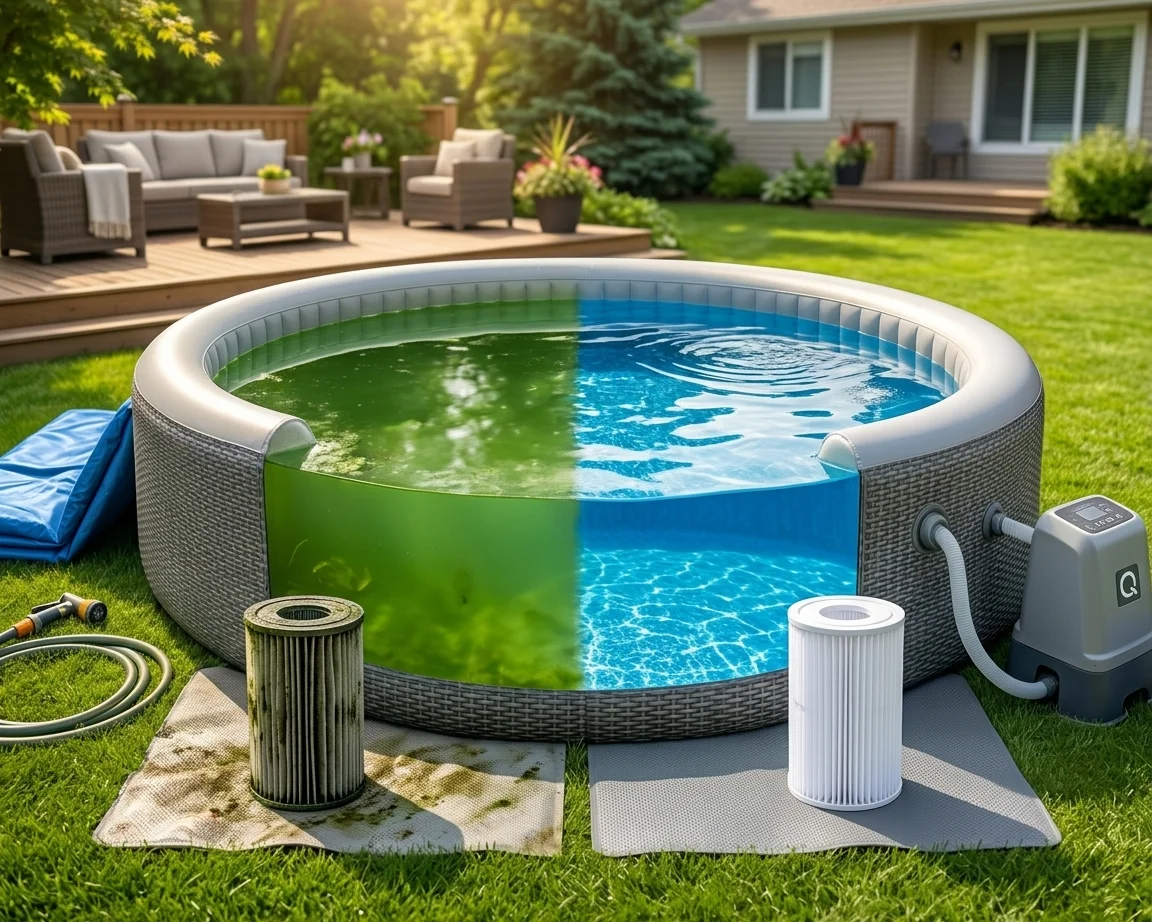
- Cloudy water that doesn’t clear despite correct chemistry — if pH and chlorine are balanced but the water stays hazy, the filter isn’t capturing fine particles effectively. A fresh cartridge typically clears this within 24 to 48 hours
If the water has already gone past cloudy and into green territory, a worn cartridge is often part of the problem our full guide on pool water turning green covers the complete fix from shock treatment to filter replacement in the right order. - Visible discolouration on the cartridge — a healthy cartridge is white or off-white when cleaned. Grey, brown, or yellow staining that doesn’t rinse out indicates the filter media has absorbed contaminants beyond recovery
- Flattened or compressed pleats — the pleated design of a filter cartridge is what gives it surface area to trap debris. When the pleats flatten, compact, or stick together, the effective filtration surface area has been permanently reduced
- Tears or holes in the filter media — any visible damage means debris is passing straight through the filter rather than being caught. Replace immediately
- Persistent bad smell from the water — filter media that has absorbed enough bacteria and organic matter develops an odour that cleaning doesn’t fully remove. This contaminates the water it’s supposed to be cleaning
- Filter runs hotter than normal — a clogged cartridge makes the pump work harder. If the pump housing feels unusually warm, check the filter first
Cleaning vs Replacing — Quick Decision Guide:
| What You Observe | Clean or Replace? |
|---|---|
| Light surface dirt and debris | Clean rinse thoroughly |
| Moderate dirt, pleats still distinct | Clean with filter cleaner solution |
| Heavy discolouration, grey or brown | Replace |
| Flattened or compressed pleats | Replace |
| Any visible tears or holes | Replace immediately |
| Cleaned but water still cloudy | Replace |
| Used for more than 6 weeks heavily | Replace regardless of appearance |
How to Clean a Pool Filter Cartridge Properly
Cleaning extends cartridge life significantly, but only if done correctly. A quick rinse under a tap might look effective but often isn’t debris packed into the pleats needs more than surface water to dislodge.
Step-by-step pool filter cartridge cleaning:
- Turn off the pump completely before removing the filter housing. Never pull a cartridge from a running system
- Remove the cartridge carefully — note which end faces which direction so it goes back in correctly
- Rinse with a garden hose — use a moderate pressure spray and work from the top down, angling the water into the pleats rather than straight across the surface. Work around the entire cartridge systematically
- Soak in filter cleaning solution — for a thorough clean, place the cartridge in a bucket of water with a filter cleaning product (or a cup of dishwasher detergent as a home alternative) overnight. This breaks down oils and fine particles that rinsing alone doesn’t shift
- Rinse again thoroughly after soaking — all cleaning solution residue needs to be removed before the cartridge goes back in. Soap residue causes foaming in pool water
- Inspect before reinstalling — check pleats are distinct and intact, no tears, no persistent heavy staining. If any of these are present, replace rather than reinstall
- Allow to dry if possible — reinstalling a dry cartridge is better than a wet one, though not always practical. Having a spare cartridge to swap in while the cleaned one dries is the ideal approach
Why Is My Pool Water Cloudy After Cleaning the Filter?
This is a common and frustrating experience you clean the filter, put it back, run the pump, and the water stays cloudy or gets cloudier. Several things can cause this.
Reasons pool water stays cloudy after filter cleaning:
- The cartridge is past its usable life — cleaning a worn-out filter improves it marginally but doesn’t restore its original filtration capacity. If the cartridge is old or heavily used, replace rather than reinstall it
- Debris stirred up during cleaning — removing and handling the filter disturbs settled debris in the system. Run the pump for several hours after reinstalling and the water should clear
- Chemical imbalance — cloudiness after filter cleaning is sometimes coincidental rather than related. Test pH and chlorine — if pH is above 7.8, chlorine becomes significantly less effective and cloudiness follows
- Filter not seated correctly — if the cartridge isn’t properly reinstalled in its housing, water bypasses the filter entirely. Check the cartridge is fully seated and the housing is closed correctly
- Algae starting to develop — early-stage algae creates a green-grey haze that looks like filtration cloudiness. Test for algae and shock treat if chlorine levels have dropped
How to Extend Pool Filter Cartridge Life?
Replacement cartridges are a running cost of pool ownership, but how quickly you go through them is largely within your control.
Habits that genuinely extend cartridge life:
Getting the most from your filter starts at setup a properly inflated pool with correctly fitted pump connections circulates water more efficiently than one where the air pump setup and inflation was rushed or done incorrectly.
- Run the pump long enough daily — a filter running 8 hours a day processes the full water volume thoroughly. Shorter runs leave more contaminants in the water between cycles, which then load the filter faster when it does run
- Rinse the cartridge weekly — a quick rinse before heavy debris builds up keeps the pleats cleaner than waiting until the filter is visibly clogged
- Skim the pool surface daily — leaves, insects, and organic debris that you remove manually never reach the filter. Every bit of debris skimmed out is debris the filter doesn’t have to process
- Shower before swimming — sunscreen, body lotion, and body oils are particularly damaging to filter media. They clog the fine pores in the filter material faster than almost any other contaminant
- Maintain water chemistry consistently — algae growth and bacterial blooms that come from imbalanced water chemistry create a sudden massive load on the filter. Balanced water means the filter handles gradual, manageable contamination rather than periodic crises
- Keep a spare cartridge — swapping to a clean cartridge and leaving the used one to soak overnight in filter cleaner gives each cartridge full cleaning time rather than rushed rinsing. This alone extends individual cartridge life by weeks
What Shortens Cartridge Life Most:
| Factor | Impact on Cartridge Life | Prevention |
|---|---|---|
| Sunscreen and body oils | Very high clogs pores fast | Rinse before swimming |
| Algae bloom | Very high overwhelms filter | Maintain chlorine levels |
| Running pump less than 8 hours | High debris builds between cycles | Set timer for consistent run time |
| Not rinsing until visibly clogged | High harder to clean effectively | Weekly rinse regardless of appearance |
| Heavy bather load without shocking | Moderate to high | Shock after heavy use |
| Hard tap water with high mineral content | Moderate | Consider pre-filter on fill hose |
How to Change a Pool Filter Cartridge
When it’s time to replace rather than clean, the process is straightforward but a few details matter for getting the seal right and avoiding pump damage.
Pool filter cartridge replacement steps:
- Turn the pump off completely and unplug it from power
- Release any pressure in the filter housing some models have a pressure release valve, others simply require loosening the housing cap slowly
- Unscrew or unclip the filter housing cap and remove it
- Lift out the old cartridge note its orientation and size before disposal
- Rinse out the inside of the filter housing with clean water to remove any debris left behind
- Check the O-ring or gasket seal on the housing cap replace it if it looks cracked, flattened, or deformed. A failed O-ring causes leaks regardless of how new the cartridge is
- Insert the new cartridge in the correct orientation most cartridges have a top and bottom that are clearly different
- Reassemble the housing, hand-tighten the cap firmly but without forcing it
- Reconnect to power and run for several hours before testing water clarity
Always buy replacement cartridges that match your pump model specifications. A cartridge with the wrong dimensions won’t seal correctly and water will bypass it entirely, giving you the appearance of filtration with none of the actual benefit.
FAQs
Here are some frequently asked questions given below:
How often should you change a pool filter cartridge?
For a family-sized inflatable pool in regular daily summer use, replace the cartridge every 4 to 6 weeks alongside weekly rinsing heavily used pools may need replacement every 2 to 4 weeks, while lightly used pools can go 2 to 3 months between replacements.
How do you know when a pool filter cartridge needs replacing rather than cleaning?
Flattened or compressed pleats, persistent grey or brown discolouration that doesn’t rinse out, any visible tears in the filter media, or pool water that stays cloudy after a fresh clean are all clear signs the cartridge needs replacing rather than another cleaning cycle.
Why is my pool water cloudy after I cleaned the filter?
The most common reason is that the cartridge is past its usable life and cleaning didn’t restore its filtration capacity replace the cartridge and run the pump for several hours. Also check that the cartridge is correctly seated in the housing and that water chemistry is balanced.
Can you extend pool filter cartridge life with regular cleaning?
Yes significantly a cartridge rinsed weekly and soaked in filter cleaning solution monthly can last two to three times longer than one that’s only cleaned when it looks visibly clogged. Having a spare to swap while one soaks overnight gives the best cleaning result.
How long does an inflatable pool filter cartridge last in summer?
With regular weekly rinsing and moderate family use, an inflatable pool filter cartridge typically lasts 4 to 6 weeks through a Canadian summer before filtration quality degrades enough to warrant replacement heavy use or poor maintenance shortens this to 2 to 3 weeks.
Conclusion
Pool filter cartridge maintenance is one of those things that’s easy to neglect until the water turns cloudy and you’re spending time and chemicals trying to fix a problem that a fresh cartridge would have prevented. The simple rule is this rinse weekly, soak in cleaning solution monthly, and replace when the pleats flatten, the discolouration doesn’t wash out, or the water stays hazy despite balanced chemistry.
For inflatable pool owners running smaller filter systems under real family use pressure, erring on the side of replacing slightly earlier rather than running a degraded cartridge too long pays off in cleaner water and a pump that isn’t working overtime against a clogged filter.
Keep a spare cartridge on hand at all times and the whole maintenance process becomes much less stressful. Browse Avenli’s full range of inflatable pool filter pumps and replacement cartridges at avenli.ca and keep your pool water clean all summer long.